
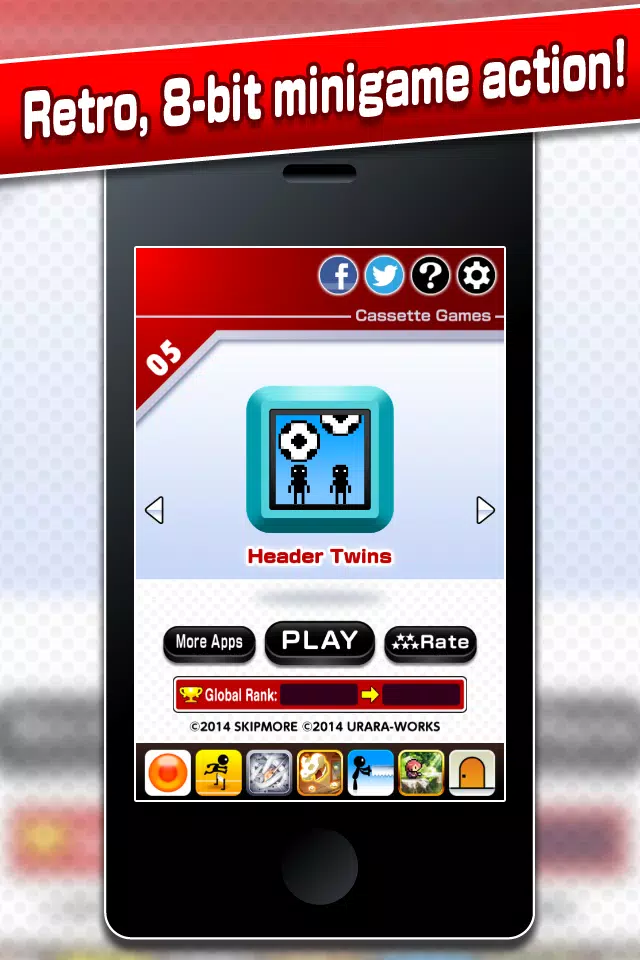
Header Twins is a compact arcade-style title where you control two stickmen at once and time headers to keep a single ball in play. The simple premise places coordination and rhythm at the center of the experience, asking for split-second timing and steady momentum rather than lengthy tutorials or complex menus. Presented as part of Cassette Games: Volume 5, Header Twins pairs minimalist visuals with short, character-driven moments and a tight mechanical focus that rewards practice and precision.
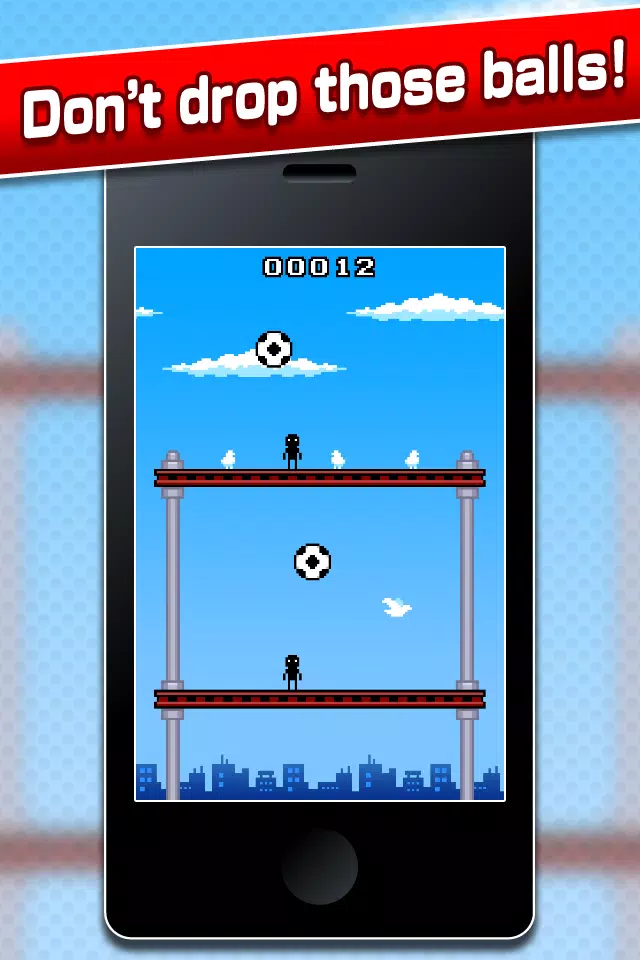
Gameplay in Header Twins revolves around one clear loop: keep the ball airborne by performing consecutive headers with both characters. The challenge comes from the interaction between movement and timing — you move the pair together and time the header taps so the ball stays within reachable range. As you string together successful headers the pace shifts, ball bounces become less predictable, and maintaining a streak requires concentration rather than memorizing long patterns. The result is a distilled arcade test of timing and spatial awareness.
Controls are intentionally simple to let the core mechanic shine. A single input performs a header while directional taps or an on-screen stick move both characters simultaneously. This unified control scheme emphasizes coordination over finger gymnastics and makes the game approachable for short sessions on a mobile touchscreen. Sensitivity feels immediate, and small adjustments to timing have noticeable effects, which helps players refine their technique over repeated runs.
Rather than an elaborate progression tree, Header Twins uses escalating challenge within each run to encourage improvement. Sessions are short but can escalate quickly depending on how long you keep the ball aloft. Missing a header breaks your streak and resets momentum, so progression is largely skill-based: better timing yields longer runs and higher scores. The title’s structure supports repeated attempts with a low barrier to restart, allowing players to focus on beating personal bests and tightening their inputs.
The visual approach is deliberately minimalist: clean stick-figure characters, readable ball physics, and simple stage backdrops that keep attention on play rather than ornament. Small bits of character banter add personality — short lines that hint at a playful, sibling relationship without interrupting flow. The palette and sound design are modest but effective, contributing to a cohesive short-form arcade atmosphere typical of the Cassette Games series.
Header Twins favors short-form sessions over sprawling levels. Each run is compact and self-contained, with the core variables — ball speed, bounce angle, and timing windows — shifting to create variety across attempts. There are no lengthy campaigns; instead, the level-like variation comes from how the ball behaves and how the two-character pairing reacts. This makes the game suitable for quick plays between other tasks and for rhythmic practice when you want to improve a particular timing window.
While the game’s scope is intentionally focused, accessibility and player comfort are considered. Controls are direct and responsive, and visual clarity is prioritized so players can follow the ball path easily. Adjustable audio levels and the ability to toggle sound effects or background music keep the experience flexible in different environments. These simple options make the game approachable for a range of players without adding menu complexity.
Replay value comes from mastery rather than content volume. Header Twins invites players to refine timing, experiment with positioning, and chase incremental improvements in run length and score. Because runs are short and restarts are immediate, the title encourages repeated practice and experimentation, which is satisfying for players who enjoy tight mechanical challenges and personal improvement over time.
The user experience focuses on immediacy: launch the game, play a run, and quickly restart if you miss. There is no reliance on online connectivity for core play, so Header Twins works well offline and in brief moments when you want a concentrated test of reflexes. The streamlined menus and quick load times keep friction low and let the gameplay loop remain the central attraction.
Created as part of Cassette Games: Volume 5, Header Twins benefits from a concise design philosophy shared across the series. Art and sound design were handled by SKIPMORE, programming by URARA-WORKS Co., Ltd., and translation by NEP, all of which contribute to a polished, compact title. Fans of focused arcade experiments will find Header Twins a tidy example of a single-concept game executed with care and clarity.