
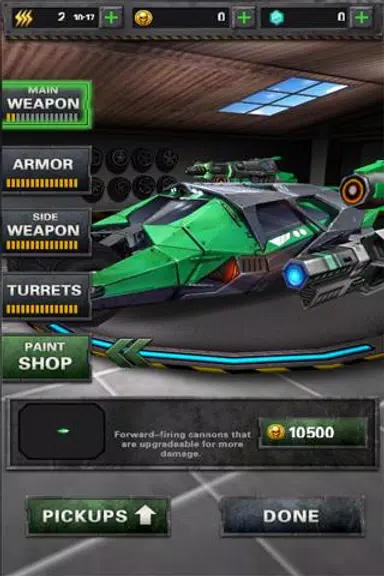
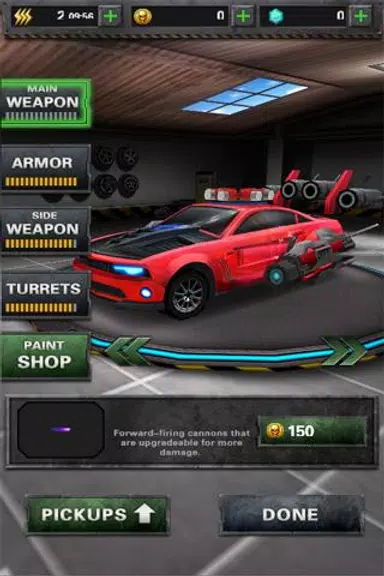


Fire Death Race : Road Killer drops you into a gritty urban world where high-speed street racing meets tactical vehicular combat. In the opening stages of Fire Death Race : Road Killer you select one of four distinct vehicles, mount primary and secondary weapons, and blast through a hazardous route filled with obstacles, enemy waves and boss encounters; the goal is survival and progression rather than simple lap times. The game offers 15 progressively difficult levels, more than 100 tasks that reward diamonds and bonuses, and upgrade systems for armor, gun turrets and other subsystems to help you adapt as threats escalate.
The core loop balances racing momentum with combat decision-making: maintain speed to outrun hazards while managing weapon cooldowns and targeting priority on the move. Vehicles handle differently—some accelerate quickly and turn sharply while others trade agility for heavier armor—so choosing the right chassis for a stage is part of the strategy. Combat blends a manual aiming feel for primary guns with automated turrets you can deploy on the fly, creating a mix of reflex-driven shooting and pre-planned defense placement. Environmental hazards and level layout influence whether you should focus on offense, defense or a hybrid approach.
Controls are designed for touchscreen play with intuitive on-screen inputs: a simple throttle and steer scheme combined with separate buttons for primary fire, secondary fire and turret deployment. Sensitivity options let you dial steering responsiveness to match your preferred control style and there are alternate control presets for players who prefer simplified taps over continuous steering. The interface is kept uncluttered so HUD elements present only critical information during tense sequences, and the game includes adjustable difficulty tuning and toggleable visual aids to improve accessibility for new players.
Progression is task-driven and transparent: completing over 100 in-game tasks grants diamonds and bonuses that you spend on upgrades. Each of the 15 main levels ends with a checkpoint and, at set milestones, boss battles that require pattern recognition and upgraded loadouts to overcome. Upgrade paths include armor reinforcement, weapon damage increases, turret effectiveness and utility modules that change how specific systems behave. Because upgrades influence survivability and performance, the game rewards consistent task completion and encourages experimenting with different upgrade combinations to find a loadout that suits your playstyle.
Levels are short, intense runs designed for pick-up-and-play sessions; typical runs last long enough to feel satisfying but short enough for mobile play. Each stage introduces varied obstacles—narrow alleys, barricade clusters, and ambush zones—that alter pacing and demand different driving choices. Visuals favor a gritty, neon-tinted urban aesthetic with weather and lighting effects that emphasize atmosphere without sacrificing clarity during combat. Enemy designs and boss visuals are distinct so you can quickly read threat types even in chaotic moments.
Customization plays a central role: you can tailor weapons, armor and turrets to emphasize speed, durability or concentrated firepower. Cosmetic options allow subtle visual personalization of each vehicle while upgrade modules change mechanical behavior rather than purely cosmetic stats. The game invites experimentation—switching weapons or adjusting turret placement can transform a stage from punishing to manageable. Fire Death Race : Road Killer supports incremental customization so even short play sessions contribute meaningfully toward a chosen build.
Challenge systems include escalating enemy waves, optional task objectives on each level and boss modifiers that change attack patterns. A spike in difficulty encourages revisiting earlier levels with improved gear to grind diamonds or complete overlooked tasks. Replay value comes from alternate routes, different vehicle archetypes and a wealth of tasks; replaying a level with a new loadout often reveals new strategies and previously unseen tactical advantages.
The experience is optimized for mobile: quick start times, short level segments and clear feedback for rewards and failures. Fire Death Race : Road Killer can be played offline for single-player runs, so you can progress without persistent connectivity. Local competition features—called leader-style challenges—let players compare scores and best times with friends on the same device or during shared sessions, giving friendly replay incentives without relying on online systems.
The game’s difficulty ramps up and places a premium on upgrades, which some players find demanding early on; enemy wave patterns can feel repetitive after extended play and progression slows if you skip many tasks. These trade-offs are balanced by short levels that encourage learning through repetition and by upgrade options that allow recovery if you focus on the right task rewards. Overall, the title aims for a tight, tactical racer-combat experience with clear progression paths and satisfying customization for players who enjoy mixing speed with strategic loadout choices.