
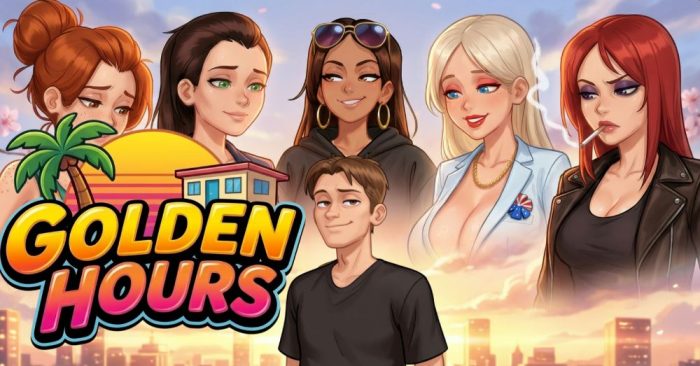
Golden Hours places you on a sunlit fictional island city where a young adult arrives just as the academic term winds down and the Festival of Lights draws near. Golden Hours unfolds as a cinematic visual novel that blends character-driven choices, social-sim mechanics and a warm tropical atmosphere inspired by Filipino city life, letting players shape multiple character arcs through dialogue, daily planning and meaningful decisions.
The story balances reflective, coming-of-age themes with branching interpersonal routes that explore romance, friendship and community ties among adult characters. Scenes are written to reflect local cultural flavor and the rhythms of island life rather than sensational beats, and high-definition character art and layered background illustrations create a cinematic sense of place. Dynamic sprite work and subtle body language convey emotional shifts, while branching storylines allow for diverse outcomes: some paths focus on relationships, others on personal growth or the fates of supporting characters connected to the Festival of Lights.
Gameplay centers on readable, choice-driven scenes that move at the player’s pace: simple tap controls advance text, open the scene history and select responses. Inline choices affect immediate reactions and long-term flags; a backlog makes it easy to revisit recent lines, and an auto-advance option plays narrative segments at a chosen speed for a hands-off experience. A skip function helps experienced players move past already-read material. Time and schedule mechanics act like a soft resource—deciding how to spend days between classes, festival preparations and one-on-one conversations affects access to events and relationship development.
Progression is organized around a chapter-and-event calendar that tracks the term leading up to the Festival of Lights. Each chapter contains decision nodes and optional encounters that require attention to timing and priorities; some events are only available on specific days or after particular conversations. Relationship meters and hidden flags record critical choices and determine which cutscenes and endings become available. A built-in gallery unlocks key artwork and voiced moments as milestones are reached, encouraging multiple playthroughs to discover alternate routes and the ripple effects of early decisions.
The visual presentation favors warm, tropical palettes and richly detailed environments to evoke the island’s everyday life and festival set pieces. Scenes are composed with cinematic framing to emphasize character interaction and emotional beats without overwhelming the text. Music and ambient sound are designed to be unobtrusive—subtle audio cues support pacing and help signal scene transitions so players can focus on dialogue and decision timing while still feeling immersed in the atmosphere.
Golden Hours offers modest personalization to suit reading preferences: you can set the protagonist’s name, adjust text speed and modify display scaling and font size. The interface prioritizes clarity with clean dialogue boxes and accessible menus that make tracking relationship progress straightforward. Multiple save slots and an autosave feature allow experimentation with different choices, and the scene backlog makes it easy to review earlier conversations when planning a different approach on a replay.
Accessibility options include adjustable contrast and text size to improve readability, along with controls tuned for touch devices. The game is fully playable offline after installation so you can progress through chapters without a persistent network connection. Challenge is primarily narrative and strategic rather than reflex-based: some events require careful time management and timely decisions, creating a quiet pressure to prioritize activities if you want to reach specific outcomes before the term ends.
Golden Hours suits players who appreciate deliberate storytelling, character growth and social-sim planning. If you enjoy branching narratives that reward curiosity, careful scheduling and multiple playthroughs to uncover alternate endings, this visual novel offers a layered, reflective experience with varied routes and meaningful choices. The game’s pacing, visual emphasis and accessible controls make it approachable for readers who value atmosphere and narrative consequence over fast action.