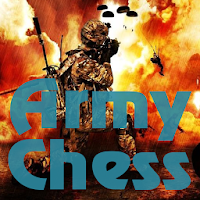
Army Chess is a tactical, two-player board game that recreates classic battle-chess play with ranked units and terrain-driven strategy. Army Chess places opposing armies on a grid where each side attempts to capture the enemy flag while managing piece ranks, special units and changing movement rules created by the board layout. The app adapts the familiar rank hierarchy—from Marshal down to Engineer—and layers in bombs, landmines and immobile objectives to produce concise, competitive matches that reward planning and positional thinking.
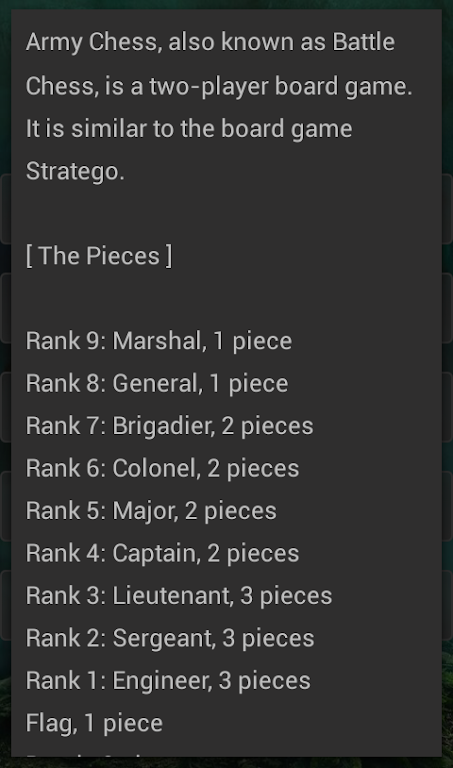
The core components are straightforward but rich in strategic consequence: ranked pieces (Marshal as the highest down to Engineer as the lowest), neutral explosive elements such as Bombs and Landmines, and an immobile Flag that ends the game when captured. Terrain on the board is meaningful: Soldier Stations, safe Campsites, Headquarters zones and Railroads change how units move and interact. Campsites offer protection from capture, Railroads allow long straight-line movement across multiple spaces, and Engineers have a unique ability to turn corners on railroad tracks. Play is strictly turn-based with alternating moves, and captures follow a simple rule where the lower-ranked piece is removed when opposing pieces meet; this clarity keeps turns fast and focused on strategy.
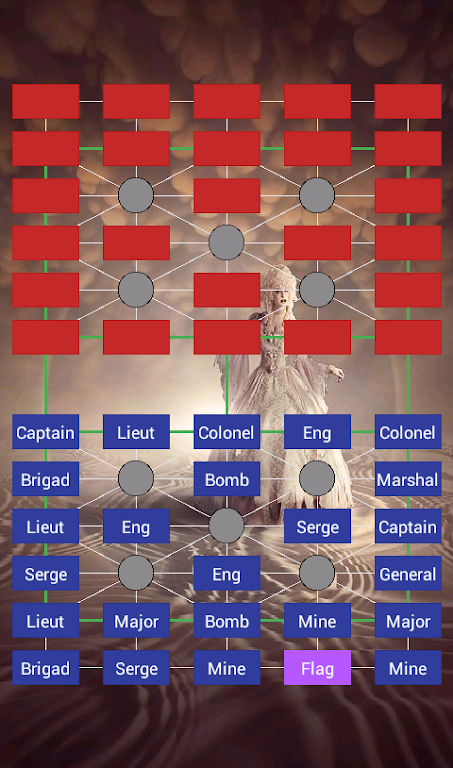
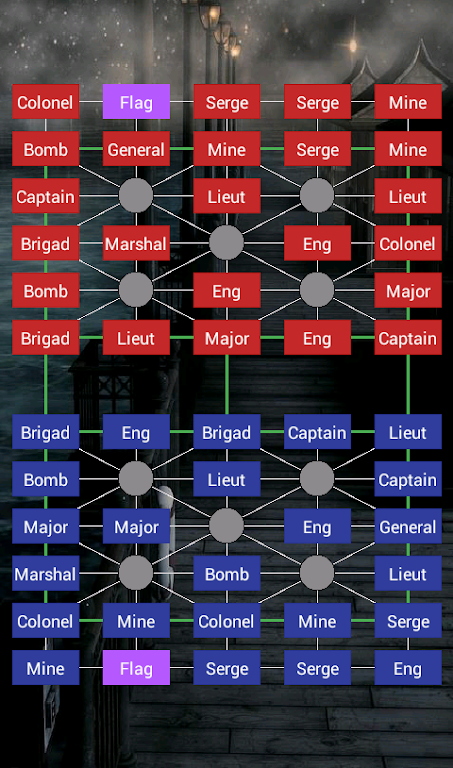
Matches begin with each player arranging or deploying their forces, then alternating single moves to advance, reposition or attack. The strategic goal is to penetrate defenses and secure the opponent’s flag while protecting your own, managing tradeoffs between high-ranked attackers and lower-ranked scouts or Engineers that exploit terrain. Because the Flag and pieces in Headquarters cannot move, games often involve both offensive thrusts and careful sieges; players must plan around immobile objectives and anticipate counterattacks. Railroads change typical movement patterns by enabling long sweeps across the board, and Engineers’ ability to traverse corners introduces new tactical lanes; understanding how terrain channels movement is central to successful play.
The app is designed for readable, intuitive interaction: select a piece and choose a valid destination with clear visual feedback for legal moves. Highlighted tiles show where a chosen piece can legally move or capture, and terrain types are labeled so players can quickly interpret how campsites, stations or railroads affect available options. The flow is optimized for short sessions—each turn is decisive—so the interface focuses on clarity: straightforward piece selection, immediate resolution of captures, and an uncluttered board view that keeps attention on tactics rather than menus.
Progression in Army Chess is represented by the evolution of a single match rather than a persistent leveling system: early-game deployments and probing moves give way to midgame exchanges where rank interactions determine trade value, and endgames center on extracting or defending the immobile flag. The depth comes from learning common patterns—how to use Campsites defensively, when to commit a high-rank piece, and how to leverage Railroad lanes for rapid redeployment. New players face a modest learning curve around Railroads and Engineers, while experienced players will find multiple layers of tactics to master in each encounter.
The visual presentation emphasizes clear, functional design so terrain and piece ranks remain readable across device sizes. The board is divided into zones that communicate purpose: safe Campsites are visually distinct, Soldier Stations mark staging points, Headquarters are clearly identified and rail lines run visibly across tiles. Piece icons are designed to show rank at a glance rather than rely on small text, supporting faster decision-making during play. The overall aesthetic leans toward a classic military chess look—clean tokens, readable counters and contrast that highlights tactical options.
Replay value comes from human-versus-human matches and the wide array of strategic choices available on each board. Because terrain and rank interactions create many possible lines of play, matches rarely feel identical: different opening moves, defensive placements in Campsites, and creative use of Railroads produce fresh scenarios. Players who enjoy experimentation will find scope to refine opening strategies, bait opponents into unfavorable trades and explore how Engineers change conventional movement patterns.
Army Chess is suitable for local, offline head-to-head sessions, making it easy to play in short sittings without network connections. The rules are presented in clear language alongside visual move indicators so newcomers can learn quickly, and the deliberate turn-based pacing reduces reliance on split-second input. These design choices make the game approachable for a broad audience while preserving the depth that strategic players expect.
Keep in mind a few practical notes: Army Chess focuses on direct two-player competition and does not include a solo campaign, so it works best as a pass-and-play or shared-device experience. Because the Flag and certain Headquarters pieces cannot move, defensive positions can sometimes become static if both players entrench; breaking stalemates requires creative use of Railroads and coordinated attacks. Finally, the Railroad and Engineer rules add strategic richness but can feel unfamiliar at first—take a few practice rounds to explore cornering maneuvers and long-line movement before jumping into competitive play.