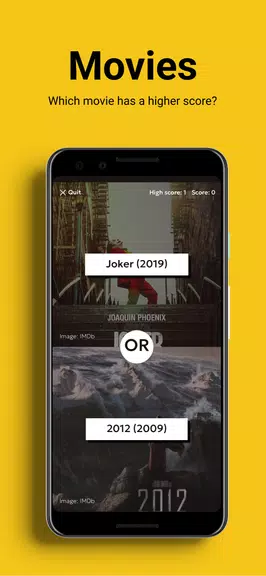
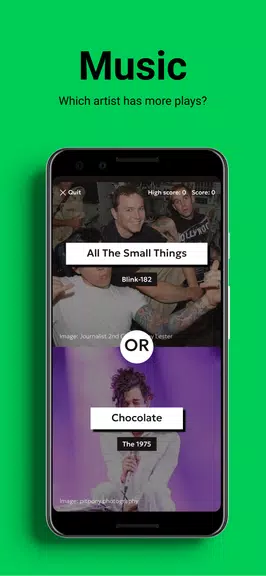
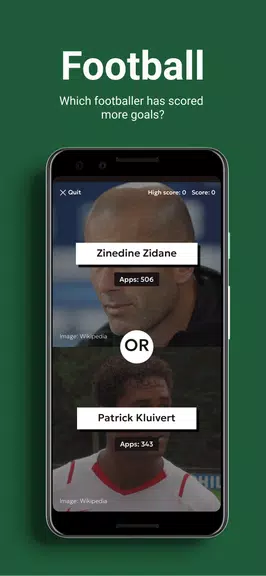
The Higher or Lower Game is a quick, head-to-head trivia challenge that asks you to pick which of two items ranks higher on a specific statistic; the app name appears here to make it clear from the start. Designed for short sessions, The Higher or Lower Game puts more than 100 themed modes at your fingertips, covering movies, music streaming figures, search popularity, country populations, major sports and celebrity comparisons so each round feels familiar but fresh.
Gameplay centers on a simple mechanic: two cards appear and you choose which item is higher (or lower) on the presented metric. Controls are intentionally lightweight — tap the left or right side of the screen to pick an answer, or swipe toward your choice for the same result — so rounds stay fast and responsive on phones and tablets. Most rounds are timed to encourage quick thinking, while some modes offer untimed practice to let you explore subjects at your own pace.
Scoring is streak-based: consecutive correct choices build a chain that increases your score multiplier and rewards consistent knowledge across topics. The game encourages incremental improvement by tracking your best streaks and high scores within each mode. Global leaderboards are available for players who want to compare rankings, and mode-specific boards let you see how you stack up against others in topics you care about. Challenge systems include timed rounds and streak milestones that unlock in-game badges and visual acknowledgements of achievement.
With over 100 modes, level structure is organized by subject and difficulty so you can quickly find sessions that match your interests. Each mode presents a steady sequence of short rounds, typically five to ten comparisons per run, which makes the game ideal for commutes, short breaks or casual competitive play. The breadth of topics and the compact round design maximize replay value: even familiar themes feel different when the specific comparisons change and streaks push you to improve.
The interface uses a clean card-based layout with readable typography and clear contrast to make choices obvious at a glance. Visual cues highlight correct and incorrect answers and the current streak so you can track progress without distraction. Customization options let you toggle sound effects and switch between light and dark themes to suit your device or environment, and basic display settings help accommodate different screen sizes.
The Higher or Lower Game emphasizes straightforward interactions and accessibility: large tap targets, adjustable text scaling, and high-contrast elements reduce strain during fast play. Tooltips and brief on-screen hints introduce new modes so players unfamiliar with a subject can understand what a metric means before they begin. The pacing and control simplicity make the game approachable for a wide age range and for players who prefer short, skill-based sessions.
Many of the game modes are playable offline using cached datasets, allowing you to enjoy rounds without a constant network connection. Some modes that rely on up-to-the-minute statistics or streaming charts may require occasional online updates to reflect real-world changes; the app notes which categories will refresh when connected. The description does not promise continuous live data for every mode, but it clarifies which subjects are static and which are periodically refreshed.
Social play options let you challenge friends locally by comparing scores or sharing results after a session, and the leaderboards provide a way to measure progress against a broader community without inventing unsupported multiplayer systems. Competitive elements are focused on improving streaks, ranking on boards, and competing in the same modes rather than on synchronous head-to-head matches; this preserves the quick, turn-based nature of the experience while still offering meaningful goals.
Some modes rely on real-world statistics and pop culture facts that can change over time, so occasional updates are needed to keep rankings accurate. Likewise, subjects that are less familiar to a given player may feel more challenging, but the broad mix of topics helps ensure there are always areas that fit different knowledge bases. The Higher or Lower Game aims to be a lightweight, repeatable quiz experience that rewards learning and quick decisions without demanding long play sessions.