


From Hero To Futa is a mature, narrative-focused visual novel designed for players who want a choice-driven experience with consequential character development. From the opening scenes, the game places you in control of Giovanna, an initially reluctant protagonist whose responses and opportunities change as her corruption level shifts. The title balances branching storylines, event-driven scenes, and a progression system that gates content based on player decisions, offering a steady sense of discovery without relying on explicit description.
From Hero To Futa delivers a branching narrative where player decisions influence which scenes are available and how characters respond. The core corruption mechanic acts as a measurable progression system: as Giovanna's corruption rises or falls, new dialogue choices, tasks, and scene variations become available. The game emphasizes exploration of environments and interactions with supporting characters, and the developers update the story content progressively so new events appear over time. An official walkthrough is provided to help players navigate particularly complex decision points and to highlight content that remains under development.
The gameplay centers on choice and consequence rather than reflex-based action. Players advance through episodic scenes, make dialogue selections, accept or decline optional tasks, and manage a corruption meter that gates access to certain options. Event triggers and small tasks create a rhythm of discovery: some scenes require cumulative choices or specific conditions, which encourages attention to narrative details and experimentation. The game is structured to reward patient exploration and strategic decision-making rather than repetitive grinding.
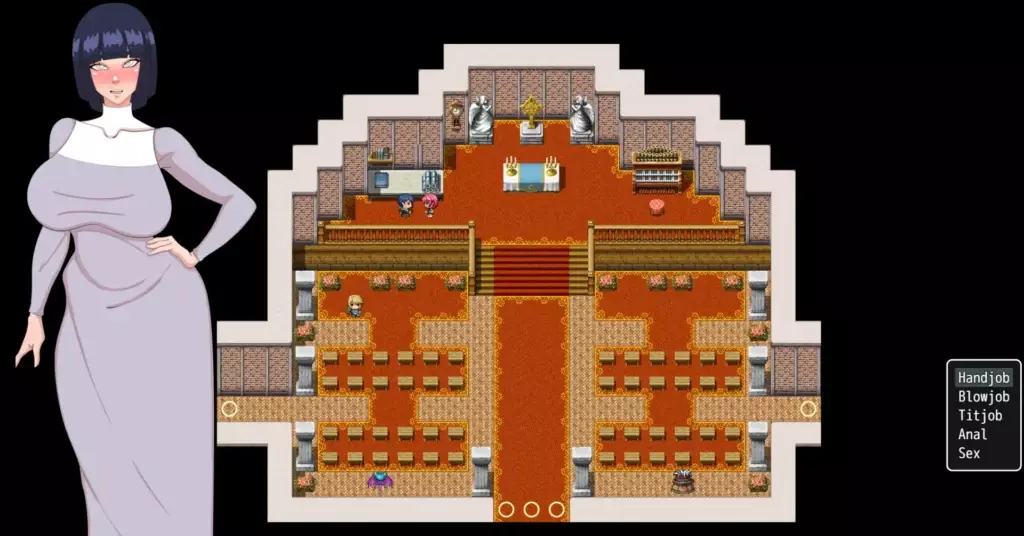
Controls are optimized for mobile play with simple tap-to-advance text, selectable choice buttons, and an on-screen menu to review objectives and load saves. Dialogue choices are clearly labeled and include contextual hints where available. The UI keeps scene information visible without clutter: portrait frames, short descriptive text, and choice panels are arranged to be readable on phones and tablets. Quick-save and multiple slot support make it easy to explore alternative paths without losing progress.
Progression is driven by a combination of the corruption meter and episodic chapter structure. The corruption meter is the principal gating mechanism: reaching thresholds will unlock new responses and actions, while lowering corruption can close off certain options and open different narrative threads. Chapters are self-contained enough to provide a sense of advancement, but they also contribute to longer arcs where earlier choices have delayed effects, reinforcing the narrative weight of decisions.
The game uses a 2D visual presentation with character portraits, background scenes, and scene-specific illustrations to convey mood and setting. Visual cues and expressive character artwork complement the written narrative without relying on explicit depiction. The art direction supports readability and immersion, with attention to lighting, color palettes, and scene framing that reflect the evolving tone of the story as Giovanna changes.
Story progression is organized into chapters and discrete events rather than traditional levels, which makes it easy to track narrative beats and return to earlier moments via saves. Customization is focused on narrative choices rather than deep avatar editing; players shape Giovanna's path through decisions that affect personality, relationships, and access to scenes. This approach keeps the emphasis on storytelling while still allowing meaningful personalization of outcomes.
The branching narrative and corruption gating create strong replay value: different choices open alternate branches and character reactions, encouraging multiple playthroughs to see alternate endings and hidden scenes. Challenge comes from managing conditions that unlock events, meeting character requirements, and making decisions with delayed consequences. The official walkthrough can be consulted for guidance, but many players will find the process of discovery rewarding on its own.
The interface is designed to be approachable for new players while offering enough depth for experienced narrative gamers. Text size options and contrast settings improve readability, and the developers aim to make scenes accessible to a broad audience. From Hero To Futa supports full offline play after initial installation, allowing players to continue their stories without a persistent network connection. Save/load functionality, multiple save slots, and clear in-game feedback help maintain a smooth experience across sessions.
Players should be aware that From Hero To Futa contains mature themes and suggestive situations that may not be suitable for everyone; explicit sexual content is avoided in the description and the presentation focuses on narrative consequences rather than erotic detail. Some scenes are still in development and may require specific choices or progression to access. If you prefer guided play, consult the official walkthrough to explore content methodically and avoid missing conditional events.
Overall, From Hero To Futa offers a decision-focused experience with layered progression, an evolving narrative, and meaningful replayability for players interested in mature, story-driven mobile games.