
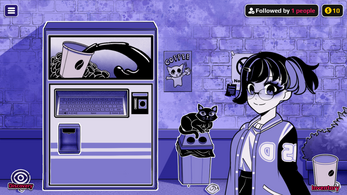



Anomalous Coffee Machine 3 drops you into a compact, surreal narrative about a struggling game artist who finds a physics-defying coffee machine in the liminal stairwell of a high-rise. Anomalous Coffee Machine 3 keeps the series' focus on short, surprising scenes: type a word, receive a mysterious cup, and decide whether to drink it, share it with a neighbor, or sell it in the game's in-world marketplace for resources. The tone mixes dark humor and unsettling imagery, and the title contains mature content intended for players aged 18 and over; content warnings and settings help manage how much graphic material appears.
The core loop is intentionally simple: you type a word and the machine generates a unique Cup of Death whose effects are determined by your input and chance. Each cup can produce transformations, short animated scenes, status effects, or narrative beats that change how the apartment building and its residents behave. Choices are lightweight but meaningful—you can experiment with different words, combine cups in your inventory, or use cups strategically to influence neighbors and unlock story branches. The unpredictability is central to the experience, encouraging creative thinking and repeated playthroughs.
Controls are designed to be immediate and accessible: text input for word generation, simple tap or click controls to select cups from inventory, and contextual menus for actions such as drinking, gifting, or listing a cup in the in-world marketplace. Animated scenes are skippable, and most interactions require only a few taps so the focus stays on experimentation rather than complex mechanics. The interface emphasizes readability and responsiveness so players can test ideas quickly and learn through trial and error.
Progression is emergent rather than level-based. As you experiment, you collect cups, discover new transformations, and earn resources that let you manage inventory and influence neighbor relationships. The game balances surprise with a sense of advancement: certain words or combinations unlock rarer results, and neighbors respond differently depending on what you give them. The challenge comes from managing risk—some cups produce beneficial outcomes, others are disturbing or dangerous—so players must weigh potential rewards against unintended consequences.
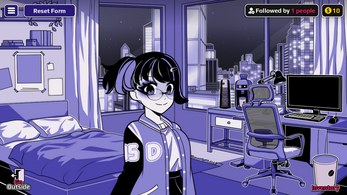
The visual presentation pairs minimalist, liminal environments with occasional detailed animated sequences to highlight key transformations. Background art focuses on the cramped, slightly uncanny atmosphere of the apartment building and its stairwell, creating an intimate setting for short vignettes. Animated scenes are used sparingly to preserve impact; when transformations occur, they are staged to serve narrative beats rather than spectacle. Visual options let players reduce animation intensity if they prefer less explicit imagery.
The game is structured around short episodes rather than formal levels: each session revolves around a sequence of cups, neighbor interactions, and emergent storylets. That episodic approach supports high replayability—different words, varied inventory combinations, and shifting neighbor states produce new outcomes. Replay value grows as the developer adds new words and forms; even within a single playthrough the order in which you encounter neighbors and events creates a fresh experience each time.
Inventory plays a central role: cups are labeled and stored so you can organize experiments, keep a collection of interesting results, and decide which items to use or dispose of. Management choices affect pacing and strategy—limited slots encourage selective keeping, while in-world sales provide a way to convert unwanted cups into resources. Customization focuses on how you approach the machine and its outputs rather than character-level cosmetics, keeping the scope tightly focused on narrative experimentation.
User experience emphasizes clarity and pacing: content warnings, adjustable text sizes, and toggles to reduce graphic detail help players tailor the experience. The game is designed to run offline for uninterrupted solo play, with progress saved locally so you can pick up experiments later. Controls are laid out to be friendly for keyboard and touch inputs, and optional hints help new players learn the consequences of common word types without spoiling surprises.
Developed by the creator of the Anomalous Coffee Machine series, the project is presented as an evolving work in progress with plans for additional words, transformations, and narrative events. Feedback and bug reports are welcomed to improve stability and polish; future updates will expand the pool of possible cups and refine neighbor interactions while maintaining the game’s surreal, choice-driven core. If you enjoy short, experimental narratives with an offbeat sense of humor, Anomalous Coffee Machine 3 offers a compact but rich sandbox for creative play.