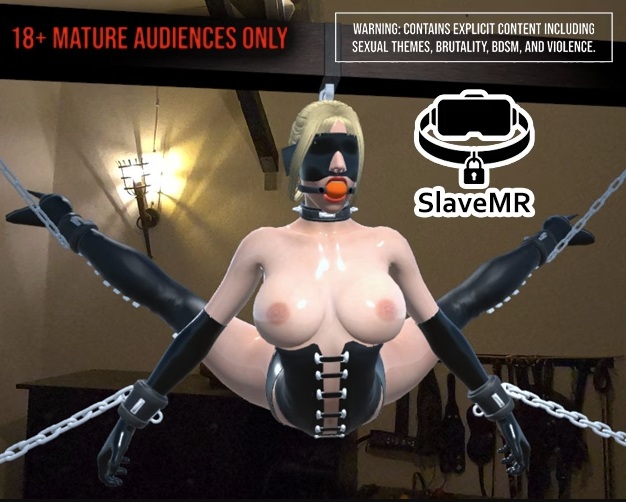
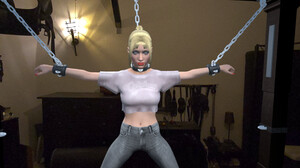

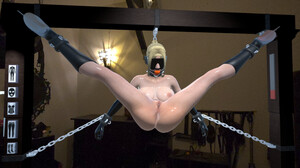

SlaveMR is a mixed-reality experience designed for mature audiences that places realistic virtual characters into a user’s real room using passthrough camera technology. The description below explains how SlaveMR approaches interaction, scene composition and technical requirements while avoiding explicit detail; it is intended to inform users about gameplay systems, customization options and the hardware needed to run the app. Readers should note that the app focuses on responsible, adult-oriented simulation and requires compatible MR-capable headsets or a capable PC and peripherals.
The core of SlaveMR is its mixed-reality passthrough integration, which maps a live view of your physical environment and overlays high-fidelity character models so scenes appear to occupy the same space as the player. The title emphasizes believable facial animations and responsive character behavior driven by layered animation systems, along with next-generation physics that influence object and character movement. Camera control and scene composition tools allow users to change angles, set poses and place props, while a range of graphical detail settings helps balance visual quality and performance on different hardware.
Gameplay in SlaveMR is driven by scene-based interactions rather than levels or direct combat mechanics; players create and direct short scenarios using a compact toolbox of controls. Input is designed for VR controllers, motion-tracked devices, or mouse-and-keyboard setups on PC, with clear mappings for camera positioning, character selection, pose editing and playback control. A context-sensitive interface lets users make incremental adjustments to timing, camera framing and interaction intensity so scenes can be paced slowly for study or set up quickly for experimentation.
Rather than a traditional leveling system, progression in SlaveMR centers on unlocking and customizing content through in-game menus. Players can save and load scene presets, unlock additional props or character variations as they explore creative options, and access a library of preconfigured templates to learn the tools. Challenge elements are optional and consist of scenario-based objectives that encourage experimentation with timing, camera composition and the physics engine; these provide structured goals for users who prefer guided tasks over freeform creation.
SlaveMR aims for a realistic visual style using detailed character models, dynamic lighting and high-resolution textures to increase immersion when virtual elements are blended with a live passthrough view. Performance scaling is built in: graphics quality, particle effects and physics fidelity can be adjusted to match the host system and headset capabilities. The result is an experience that can favor visual fidelity on high-end setups while remaining accessible in a reduced form on entry-level hardware.
Scene editing is a central aspect of the user experience, allowing creators to configure poses, adjust facial expressions, place props and control camera lenses and angles. Multiple save slots and preset management make it possible to iterate quickly and store different scene variations for later use. The customization tools are non-destructive, meaning changes can be reversed or refined without losing previous configurations, supporting a creative workflow that rewards gradual refinement.
Replay value in SlaveMR comes from the combinatorial possibilities of character states, camera positions and prop interactions; small changes to timing or framing yield noticeably different results. Users can approach the app as a sandbox for composition, a study tool for animation and lighting, or a means of exploring mixed-reality spatial relationships. The interface design emphasizes clarity and repeatability so users can reproduce favored setups and build a personalized library of scenes over time.
SlaveMR supports local playback and editing without requiring an online account, so scenes and presets are available offline once installed. Control sensitivity, subtitles for UI prompts, and adjustable comfort options are provided to improve accessibility for users with different needs. The app includes options to reduce motion intensity, simplify interface elements and remap controls to accommodate a range of input devices and physical setups.
The app contains adult-oriented themes and is intended only for mature users; it avoids explicit descriptions and focuses on simulation mechanics. Mixed-reality passthrough features require compatible MR headsets or a PC with appropriate capture hardware, and higher-fidelity visuals demand a capable GPU and sufficient memory. Users should review compatibility notes before installing to ensure their hardware supports the intended features and to understand any regional restrictions on adult content.
The current public release is Final Version 2.0 (Full Game), which consolidates the described feature set, improves animation responsiveness and expands scene-saving and preset management. Updates in this release include optimizations to the physics layer and additional camera controls, along with bug fixes for passthrough alignment. For users evaluating the app, SlaveMR provides in-app documentation that outlines controls, system recommendations and tips for getting consistent results across different room layouts and lighting conditions.