


Missguided Lifes is a narrative-driven game that places players inside the subtle, everyday rhythms of a small-town household where routine tasks conceal emotional tensions and complex choices. In Missguided Lifes you follow a devoted psychologist who navigates professional ethics and family needs, Lisa, a central family character whose relationship with her parents is shaped by decisions, and a career-focused partner who often prioritizes work over home life. The game emphasizes human relationships and realistic consequences, inviting players to influence how this household communicates, grows, or drifts apart through choice-driven storytelling.
Missguided Lifes centers on character interactions and situational dilemmas rather than action-oriented gameplay. The core loop is built around conversation branches and decision points that reveal motivations, secrets, and conflicting priorities. Each choice has measurable impact on how other characters perceive the protagonist and each other, enabling gradual changes in trust, respect, and cooperation across the narrative.
The game presents a small-town, everyday environment where ordinary tasks—from household chores to professional challenges—become scenes for emotional development. Players will encounter private conversations, polite confrontations, and quiet compromises that require empathy and strategic thinking. These moments are framed as accessible episodic scenes, each designed to feel like a contained chapter within a larger family story.
Gameplay in Missguided Lifes relies on intuitive tap-and-select controls optimized for touch devices. Players choose dialogue options, decide whether to intervene or observe in tense moments, and occasionally select items or locations that unlock additional lines of interaction. The interface focuses on readability and fast responses, with a simple timeline showing recent decisions and their resulting changes to relationships.
Decisions can be immediate or deferred: some scenes allow careful consideration with additional context provided, while others introduce mild time pressure to reflect real-life urgency. There are no reflex-based challenges; the difficulty comes from evaluating trade-offs between long-term trust and short-term stability. Controls remain consistent across scenes so players can focus on the narrative rather than adjusting to new input schemes.
Progression is driven by narrative chapters and relationship metrics rather than levels or combat. As players make choices, relationship states evolve and new narrative paths unlock. Certain scenes and character revelations become available only after specific interactions, encouraging multiple playthroughs to see alternative perspectives and endings. The game supports branching outcomes, so the same sequence of events can lead to different reconciliations, estrangements, or compromises depending on choices.
Replay value comes from discovering unseen conversations, testing different conflict-resolution strategies, and observing how small gestures or withheld words ripple through the family dynamic. The game is structured to accommodate both short sessions—complete a single chapter in 10–20 minutes—and longer play sessions that follow a character arc across multiple chapters.
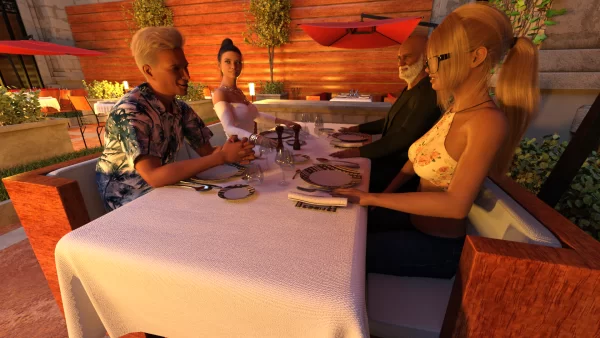
Missguided Lifes favors a grounded visual approach that highlights facial expressions, interior settings, and quiet moments rather than flashy effects. Character portraits and scene layouts use warm palettes and restrained animation to support an intimate storytelling tone. Backgrounds evoke a compact, familiar town with locations such as a family home, a small clinic, a neighborhood cafe, and quiet streets where meaningful conversations occur.
The audio design is subtle: ambient soundscapes and understated music underscore emotional beats without overwhelming dialogue. Text presentation is clear and well-paced, with options to adjust reading speed for players who prefer to move through scenes at their own tempo.
Missguided Lifes is designed to be approachable for a wide audience. Text size and contrast settings can be adjusted to improve readability, and all voiced lines are accompanied by readable subtitles. The interface supports simple navigation for players with limited mobility, and the game can be paused at any point to consider next steps. A full offline mode lets players experience the narrative without an internet connection, making the game suitable for travel or areas with limited service.
This title is intended for players who enjoy slow-burning, character-driven storytelling and moral reflection rather than fast-paced action. Missguided Lifes rewards thoughtful play: listening, choosing with care, and observing the subtleties of interpersonal dynamics. While the pace is deliberate and may not appeal to players seeking arcade-style thrills, it offers a rich, contemplative experience for anyone interested in believable characters, branching narratives, and the small, consequential decisions that shape relationships.