
Wizardry Variants Daphne reimagines classic dungeon-crawl role-playing with modular rulesets, emergent difficulty and deep party management. This version blends traditional turn-based combat, customizable encounters and a sandbox of optional variants for veterans and newcomers alike, delivering a dense retro RPG experience that rewards careful planning and exploration.
Wizardry Variants Daphne is built for players who enjoy complex systems and freedom to tune challenge and mechanics. It retains the feel of old-school tabletop-inspired adventures while introducing variant rules you can enable or disable. The result is a flexible RPG platform that supports both short sessions and long campaigns.
Unlike many modern handheld RPGs, the game places emphasis on systems over hand-holding. You will manage resources, map corridors by hand, and face encounters that require tactical depth. Modularity is central: you can create a pared-down experience or crank up the permutations to create an unpredictable dungeon crawl.
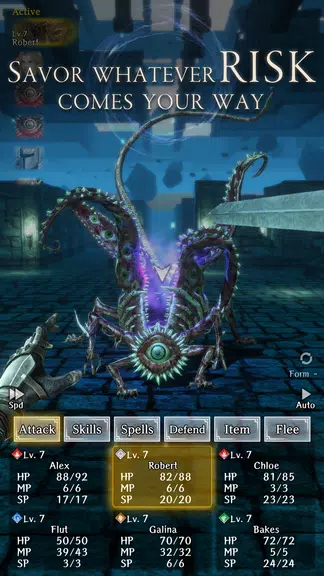
The heart of Wizardry Variants Daphne is its turn-based combat and party progression. Battles play out on a gridless arena with positional considerations, initiative shifts, and class synergies. Classes and races interact with variant rules that adjust how experience, spells and equipment behave, so party composition matters more than raw levels.
Leveling can be adjusted to be faster, slower, or nonlinear. Variant rules change how stats scale and how equipment upgrades affect performance. That makes the progression system feel deliberate: choices made early can cascade into late-game strengths or liabilities.
The interface is intentionally utilitarian: clear menus, text-heavy descriptions and minimal hand-holding. That suits the target audience but there are quality-of-life tools such as quick-save hotkeys, encounter logs, and variant toggles that let you experiment without losing progress. Inventory screens and spell lists are accessible and designed around efficiency for veteran players.
One of the strongest draws is the ability to customize the ruleset. Variant toggles cover enemy scaling, loot distribution, magic behavior and more. For players who enjoy tinkering, these settings allow you to create a tailored campaign experience. Modding communities often share presets that replicate classic rulesets or introduce novel mechanics.
Graphically, Wizardry Variants Daphne embraces retro aesthetics. Pixel art tiles and minimalist UI prioritize readability and atmosphere. Sound design favors ambient tones and sparse battle cues, reinforcing the sense of exploration and tension over flashy presentation.
Start with a conservative variant set and a balanced party to learn core mechanics. Focus on scouting, managing consumables and learning enemy patterns before enabling harsher rules. Save frequently and experiment with small changes to see how variants influence encounters. For players migrating from modern RPGs, allow extra time to adapt to resource-driven pacing.
Replayability comes from the combinatorial nature of variants. Changing a few toggles can transform how spells work or how monsters scale, producing fresh challenges. The player community is a resource for strategies, preset configurations and shared dungeon challenges, making collaborative improvement part of the long-term appeal.
Installation is straightforward: download, grant storage permissions, and familiarize yourself with the options menu before beginning a campaign. Spend a couple of sessions exploring variant settings in a low-risk save file to understand their cumulative effects. The learning curve is intentional but rewarding for those invested in strategy.
Fans praise Wizardry Variants Daphne for depth, customization and adherence to classic dungeon-crawl design. Its emphasis on player choice and the ability to fine-tune difficulty make it a strong pick for those who enjoy methodical, system-driven RPGs. Players who value tactical planning and modular rulesets will find a rich sandbox to craft their own adventures.