
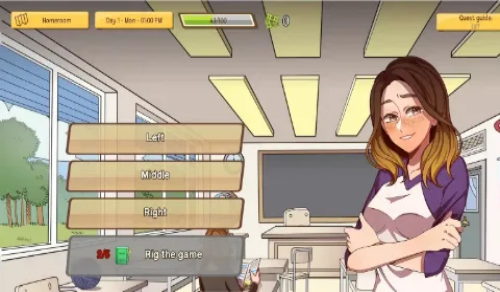
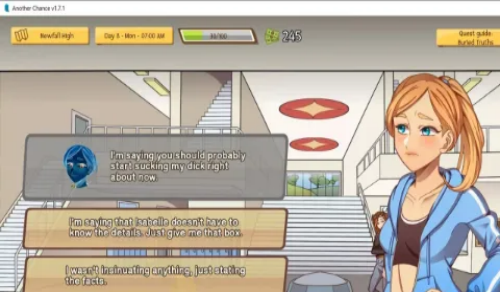
Another Chance is a narrative-driven puzzle adventure that blends stealth, choice-based storytelling, and time-rewind mechanics to give players new opportunities to correct mistakes and explore alternate outcomes. Set across interconnected levels, it challenges decision-making while rewarding clever problem solving and careful planning.
Another Chance places emphasis on consequence and adaptation. Each level introduces a compact scenario where your actions ripple outward, opening or closing paths and altering character relationships. The core loop asks you to observe, act, and then use a limited rewind or retry system to test different approaches without restarting entirely.
The game’s systems are simple to learn but nuanced in execution. Stealth tools and environmental puzzles require you to consider sightlines, patrol patterns, and discreet interactions. As you progress, new mechanics—such as remote gadgets, distraction items, and dialog branches—are introduced to expand both tactical and narrative possibilities.
Levels in Another Chance are designed as compact arenas with multiple viable solutions. Urban rooftops, enclosed facilities, and cluttered interiors all present unique movement and line-of-sight challenges. The game favors verticality and interconnected routes, encouraging players to scout alternate paths and exploit environmental objects to create distractions or shortcuts.
Success depends on observation and planning rather than reflexes. Players benefit from mapping guard routines and anticipating how a single altered action will cascade through a level. The rewind feature becomes a tactical tool: test an approach, rewind to a key decision point, and pivot to a different strategy once you’ve gained new information.
Dialogue choices matter. NPCs react to your behavior and reveal layers of story through repeated encounters. Another Chance frames narrative progression as a series of small revelations unlocked when you revisit characters with fresh context, turning repeated failures into meaningful story beats.
Controls are tuned for touchscreens with context-sensitive gestures for stealth moves and item usage. Performance is optimized for a wide range of devices, with scalable visual settings and optional effects toggles to maintain smooth frame rates. Accessibility options include adjustable difficulty for detection sensitivity and an assist mode that extends rewind windows.
The aesthetic leans toward stylized realism: clear silhouettes, readable lighting, and subtle animation cues that convey guard attention and environmental hazards. Sound plays a key role, with audio cues used to mask or reveal movement, making headphone play particularly immersive.
Begin with tutorial levels that introduce stealth basics and the rewind feature. Focus on learning one mechanic per run—observe, adapt, and then refine. Save upgrades for tools that match your preferred playstyle, whether that’s non-lethal stealth, gadget-driven manipulation, or social engineering through dialogue.
Another Chance rewards thoughtful play and curiosity. Its design encourages players to view setbacks as information rather than failure, transforming repetition into a satisfying puzzle of cause and effect. The blend of narrative stakes and mechanical depth creates an experience that scales with the player’s willingness to experiment.