
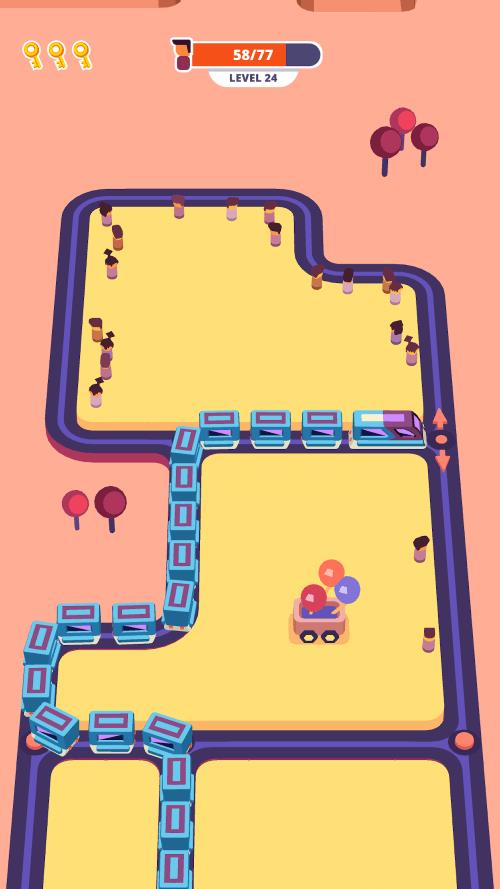
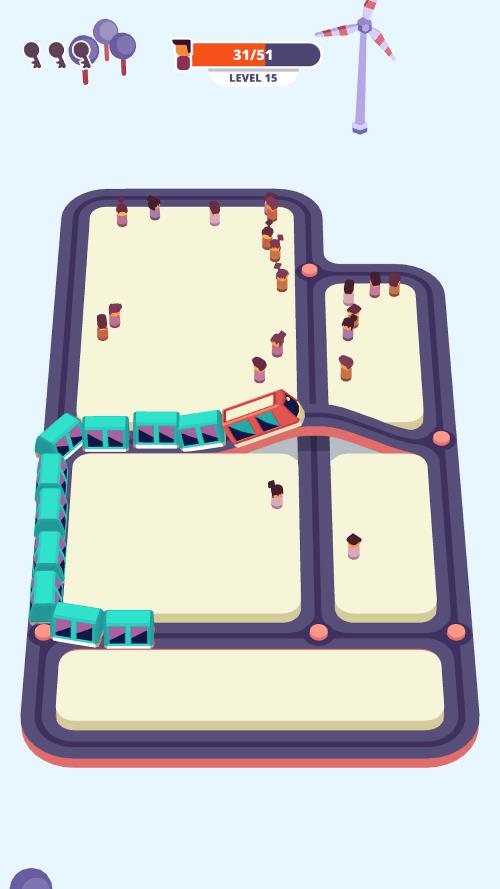

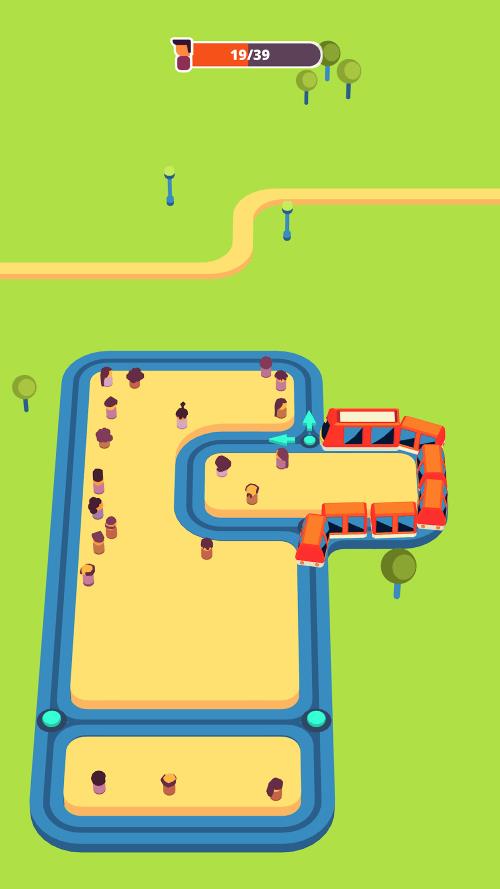

Train Taxi delivers a compact, puzzle-driven driving experience that blends rail logic with taxi-style passenger pickups. Players route vehicles on interconnected tracks, time stops and manage traffic to reach goals across increasingly complex maps. The game emphasizes planning, quick decisions, and satisfying chaining mechanics for score-focused play.
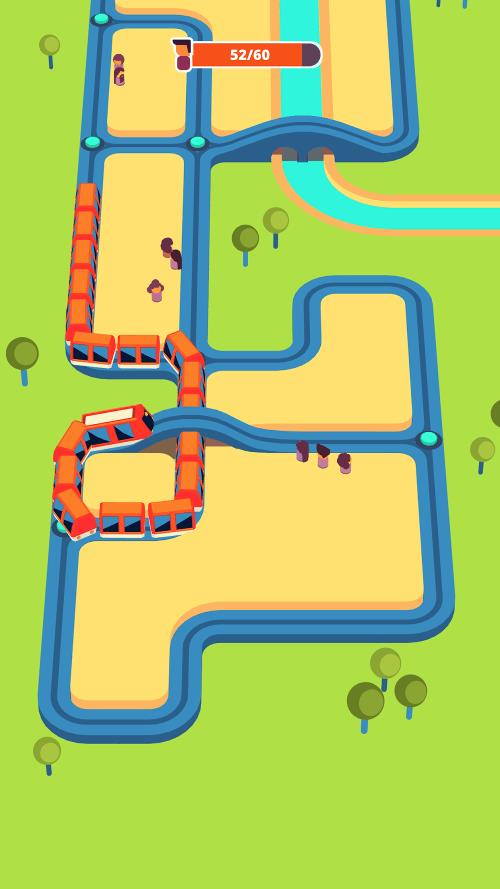
Train Taxi mixes two familiar mechanics: the route planning of railway puzzles and the pick-up/drop-off tempo of taxi simulators. Each level presents a grid of rails, junctions and stations. You must assemble efficient journeys, avoid collisions and maximize earnings or points. Difficulty builds steadily, introducing new hazards and layered objectives that keep sessions engaging.
At the heart of Train Taxi is a simple but deep loop: receive passenger requests, choose routes, and control timing. Early stages teach basic switching and timing. Later stages require juggling multiple taxis and coordinating signals so that trains do not block each other. Success depends on reading the map, predicting vehicle movement, and adapting plans on the fly.
The game uses a few interconnected systems that reward foresight. Track switches let you reroute trains; scheduled stops handle drop-offs; and a signaling system helps prevent deadlocks. There is also a scoring multiplier for chaining consecutive successful pickups without delays. These systems make each decision meaningful: a poorly timed switch can cascade into long delays.
Controls are designed for quick interactions. Taps or clicks toggle switches and set waypoints. A concise HUD shows active objectives, pending passengers and a mini-map of upcoming segments. The interface focuses on clarity. Visual cues such as highlighted tracks and color-coded vehicles reduce cognitive load so you can concentrate on strategy rather than deciphering the display.
Train Taxi offers diverse maps that introduce new challenges rather than repeating the same layout. Urban maps emphasize dense routing and many short trips. Rural or industrial maps include longer tracks and timed obstacles like closing bridges. Progression unlocks new vehicle types and special tiles — such as speed boosters or temporary one-way segments — which expand the puzzle space and require fresh tactics.
Players can tune their fleet through upgrades that affect capacity, acceleration and braking. Cosmetic options let you personalize vehicle appearance and station themes. These choices don’t alter core balance dramatically but add a sense of ownership and incremental improvement as you tackle harder scenarios.
Train Taxi opts for a clean, stylized look that communicates information efficiently. Color-coded rails and readable icons help players scan complex scenes quickly. Sound design supports gameplay with distinct chimes for pickups, subtle rumble for movement and minimalistic background music that keeps focus. The title runs smoothly on mid-range devices thanks to optimized effects and lightweight assets.
This game appeals to players who like methodical puzzles and logistical challenges. If you enjoy planning, timing and incremental improvement, Train Taxi rewards persistence and experimentation. It’s also suitable for short sessions: a single level can be completed in a few minutes, making it a good fit for commutes or breaks.
Getting started is straightforward: complete the tutorial, play a few early maps to learn timing, and gradually take on more complex scenarios. Train Taxi balances accessibility with depth, so beginners can make progress quickly while veterans find strategic layers to master. Whether you prefer short puzzle bursts or longer planning sessions, the game delivers satisfying logistical challenges with clear visuals and responsive controls.