

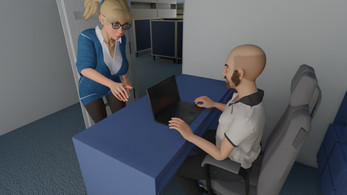



Julia and the Office is a narrative-driven puzzle-adventure that puts you in the shoes of Julia, a new hire trying to make sense of quirky co-workers, small workplace mysteries, and time-sensitive tasks. The game blends light puzzle mechanics with branching dialogue and short chapters that are easy to pick up between errands or during a commute. Players will find bite-sized levels that reveal character details and workplace secrets as they progress, with a steady learning curve that welcomes both casual and thoughtful play.
At its core, Julia and the Office mixes simple logic puzzles and situational tasks with choices that influence later encounters. Typical objectives include organizing files, reconciling a dispute, solving a scheduling riddle, or decoding a suspicious memo. Each level presents clear goals and small environmental puzzles that can be approached in different ways, and optional timers or limited moves are introduced later for players who want additional challenge. Dialogue branches alter coworkers' reactions and open up new side objectives, so decisions matter without becoming a barrier to progress.
The interface is optimized for touch: tap to interact with objects or people, drag to arrange items on desks or in cabinets, and pinch to inspect detailed notes or photos. Controls are intentionally streamlined to reduce friction, with contextual prompts and one-touch tutorials during early levels. A built-in hint system helps when players get stuck, and skip options are available for some dialogue scenes to keep the focus on puzzles for those who prefer faster sessions.
Levels are compact and varied, designed for short play sessions that still feel meaningful. Office floors and departments introduce new props and mechanics such as shared printers, locked cabinets, and informal rumor networks that affect task availability. Characters are written with distinct personalities — an overworked manager, an overly chatty intern, and an enigmatic IT specialist — each responding to Julia's choices in believable ways. Revisiting locations with different approaches reveals hidden interactions and alternative outcomes, which encourages exploration and experimentation.
Progression combines earned resources and relationship meters that reflect how coworkers perceive Julia. Completing objectives rewards small perks like access to new tools, helpful hints for tougher puzzles, or shortcuts through the office map. Balancing short-term puzzle solutions with long-term relationship building creates strategic depth: choosing to help a colleague immediately may unlock assistance later, while ignoring a social cue can close a path. The design favors multiple puzzle solutions and branching objectives rather than a single linear route.
The visual approach favors clean, hand-drawn environments and expressive character portraits that communicate emotion without relying on heavy animation. Subtle movement and comedic beats are used sparingly so the art supports storytelling without distracting from puzzle-solving. Audio design emphasizes ambient office sounds and light piano themes to create a cozy, slightly absurd atmosphere; all audio channels can be adjusted or muted independently to suit different listening environments.
Julia and the Office features modest customization options that let players personalize their experience: cosmetic desk items, wardrobe choices for Julia, and small office decorations unlocked through achievements. More important for replay value are branching dialogue paths and multiple puzzle solutions that unlock alternate scenes and objectives. Players who enjoy experimenting with different approaches will find new narrative beats and relationship outcomes by replaying levels with different priorities or strategies.
The game is optimized for a wide range of Android devices, with sensible asset scaling and a low memory footprint to ensure stable performance on mid-range phones while taking advantage of higher-end hardware for smoother animations. Battery and data use remain modest, and the core experience is fully playable offline once installed. Accessibility options include adjustable text sizes, clear visual cues, and difficulty settings to accommodate different playstyles and reading preferences.
Install and jump into the tutorial to learn basic interactions and meet the main cast; early objectives introduce the game's rhythm and reward curiosity. Short chapters make it easy to step away and return without losing momentum, and as you become familiar with mechanics, new layers of strategy and storytelling will appear. Julia and the Office aims to deliver a calm, character-driven puzzle experience that encourages exploration, replay, and thoughtful choices rather than fast reflexes.