

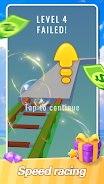


Skate Spin 3D puts reflex-driven ice skating action into compact stages and challenges players to bend, twist and weave around moving obstacles. From the first run you can tell this skating title favors short, intense play sessions where timing and body positioning are more important than long combos. Skate Spin 3D offers a focused experience for anyone who enjoys improving reaction speed and mastering tight windows of opportunity on each level.
The core of the game is fast-paced obstacle navigation that tests timing and agility rather than complex controls. Levels are designed to escalate in difficulty, introducing new obstacle patterns and tighter gaps as you progress. The game emphasizes a simple bend-and-dodge control scheme that rewards precision, while stage design encourages experimentation with route choice and timing. Visuals and audio cues are used to telegraph incoming hazards so players can learn and adapt.
Gameplay centers on short, repeatable runs that challenge your reflexes and situational awareness. Each stage presents a series of moving or appearing obstacles that require quick lateral movement and well-timed bends to pass safely. The design encourages learning by doing: repeated attempts reveal consistent patterns and timing windows, allowing players to develop strategies for each stage. Risk-and-reward moments occur when tighter lanes offer faster completion but less margin for error, so decision-making plays as big a role as raw speed.
Controls are intentionally accessible: basic gestures or taps control lateral shifts and bending maneuvers so new players can start immediately while still offering room to refine inputs for higher-level play. The response is tuned to feel immediate, with clear feedback for successful dodges and collisions. On-screen indicators and subtle haptic or visual cues help with timing, and control sensitivity can be adjusted in the settings to accommodate different play styles and devices.
The progression system is straightforward and focused on steady challenge growth. Early stages introduce single obstacle types and generous timing windows, while later stages combine patterns, speeds and spacing to create multifaceted tests of reaction and route planning. Levels are short by design to encourage repeated attempts and practice, and difficulty ramps consistently so players can feel improvement as they learn new patterns and refine movement precision.
Skate Spin 3D favors a clear and readable visual approach that highlights obstacles and movement paths rather than flashy effects. Simple environmental details create a sense of place without distracting from the gameplay, and color contrasts are used to make hazard types and safe zones immediately identifiable. Animations emphasize fluid body motion and responsiveness so players can anticipate movement based on visual cues alone.
While core mechanics remain minimal to preserve accessibility, the game provides basic customization to tailor the experience. Players can adjust control sensitivity and visual contrast, and choose between shorter or slightly longer run lengths to match the desired session length. These options help accommodate different hand sizes, device types and play preferences without changing the fundamental challenge design.
Replay value comes from the short-stage format and layered obstacle patterns that invite mastery. Each run feels meaningful because a single successful response can net a better completion time or smoother sequence. Challenge modes and optional harder stages reward precision and practice, offering players a way to test refined skills without altering the casual-friendly core experience. The structure encourages iterative improvement rather than long grind sessions.
The interface is designed for quick access: intuitive menus, clear stage previews and immediate retry options keep players in the flow. Accessibility options such as adjustable control sensitivity, visual contrast settings and simplified input modes aim to make the game approachable to a wide audience. Skate Spin 3D is playable offline, allowing short practice sessions without a network connection and making it a convenient pick-up-and-play option for commuting or breaks.
New players should begin on early stages to learn movement timing and obstacle telegraphing, then revisit completed stages to improve consistency before moving to more complex patterns. Consistent short sessions will typically yield the best improvement in reaction speed and timing. For players who enjoy tight reflex tests, this skating title delivers concentrated challenges that reward patience and practice.