

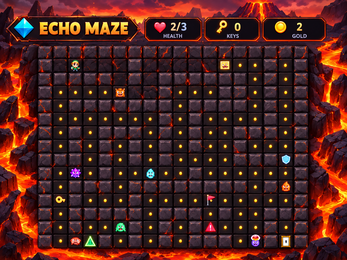
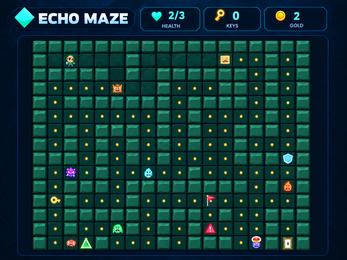
Echo Maze is a stealthy puzzle-adventure that blends sound-based navigation with layered level design. Players use echoes to reveal hidden corridors, avoid traps, and outsmart patrols. This compact premise creates tense exploration and clever problem-solving across dozens of handcrafted stages and escalating mechanics.
Echo Maze centers on listening and movement rather than combat. Each level feels like a miniature riddle: send a sound pulse, watch light and shadow respond, and map the environment with limited sensory feedback. The designer intent is clear — challenge players to think in echoes, plan steps ahead, and value patience over speed.
Gameplay relies on a few tightly integrated systems. Players emit brief sound bursts to scan surroundings; audible cues reveal walls, floors, and patrol paths. Enemies react to noise, so every ping is a risk-reward decision. Puzzle elements include timed doors, pressure plates, one-way passages, and movable obstacles that must be navigated using acoustic traces.
Stages start simple and increase in complexity, introducing new hazards and mechanics gradually. Early levels teach echo mapping basics, then layer in enemy types that have varied detection patterns. Later zones require chaining actions, like coordinating decoys with movement or manipulating the environment to create safe corridors. Checkpoints are spaced to keep frustration low while preserving a satisfying difficulty curve.
Echo Maze equips players with a small toolkit that expands over time. Basic items include sound grenades that mask your pulses, tether devices that hold doors open, and reflectors to bounce echoes into blind spots. Each tool encourages creative problem solving rather than brute force, turning limited resources into strategic options.
The control scheme is compact and intuitive. Movement is precise, and the echo pulse is mapped to a single action for quick use. On-screen indicators display recent echoes and enemy alert levels without cluttering the view. Menus are minimalist, concentrating on level selection, tool loadouts, and short tutorials for new mechanics.
Graphics favor contrast and clarity to support the sound-centric gameplay. Environments use muted palettes with bright highlights where echoes interact with geometry. This design helps players parse acoustic feedback visually. The engine runs smoothly on modest hardware, and options allow players to prioritize framerate or visual fidelity depending on their device.
Echo Maze offers a steady rhythm of quiet exploration punctuated by tense moments when a misstep triggers alarms. Session lengths are flexible: a few levels can be enjoyed in short bursts, while completionists can invest longer sessions to master optional challenges. The game rewards observation and experimentation more than twitch reflexes.
Echo Maze strikes a pleasing balance between puzzle complexity and accessibility. The sound-driven mechanics feel fresh, and the steady introduction of new tools keeps the gameplay loop engaging. Players who enjoy methodical problem solving and spatial reasoning will find a lot to appreciate here.
Jumping into Echo Maze is straightforward: complete the tutorial to learn core interactions, then tackle the main campaign at your own pace. Pay attention to early levels — they teach principles that become essential in advanced stages. With patience and practice, the satisfaction of cracking a difficult maze is highly rewarding.