
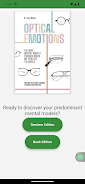



Optical Emotions is a focused self-assessment and practice tool that helps readers identify recurring thought patterns and develop practical habits to interrupt unhelpful reactions. Built as a companion to the book Optical Emotions: Eight Mental Models Through Which We Perceive the World, the app guides you through a structured quiz and targeted exercises designed to increase clarity, emotional intelligence, and intentional perspective shifts.
The core of Optical Emotions is a Mental Models Self-Assessment Quiz that uses tappable sliders to rate short statements on a 1–10 scale. Results present a concise summary that highlights your three predominant mental models and explains the ways those models tend to shape perception and behavior. For each dominant model the app provides tailored 'disablers'—short, actionable strategies you can use in the moment—and a curated set of exercises for deeper practice. The app also includes brief tips linking the exercises back to the concepts discussed in the book to help users apply theory to daily life.
The assessment is broken into small, easy-to-complete sections so you can pause and return without losing context. Each quiz item appears with a short description and a slider control; moving the slider updates real-time feedback so you can feel how your selections shape your profile. After completion, the app generates a personalized summary that explains which three mental models are most active and why, then recommends the most relevant disablers and practice modules. Exercises are grouped by theme and range from brief in-the-moment prompts to longer reflection practices intended for repeated use.
Designed for mobile use, controls are simple and intuitive: tappable sliders, clearly labeled buttons to start or retake assessments, and swipe-friendly navigation between exercises. Interactive elements provide immediate visual confirmation of your choices and brief microcopy explains what each control does. You can bookmark specific exercises for quick access and mark items as 'practiced' to keep a personal record of what you’ve tried. The interface emphasizes speed and clarity so assessment and practice can fit into short daily routines.
Progress is measured through practice history rather than gamified points: the app records which exercises you use, how often you repeat them, and how your self-assessment profile changes over time. Recommended sequences suggest a progression from short disablers to deeper exercises as you build familiarity with a model. Optional daily prompts and timed practice sessions create gentle challenges meant to encourage consistency, while periodic re-assessments let you track subtle shifts in perception and reinforce replay value through measurable personal growth.
The visual design emphasizes readability and calm: a restrained palette, clear typography, and a layout that echoes the book’s practical tone. You can adjust text size and contrast settings to suit your reading preferences, and the content structure—short prompts, summaries and exercises—keeps focus on practical work rather than dense theory. Customization options let you prioritize particular models or mark exercises you prefer, so the app adapts to the way you learn and practice.
The app is built to work reliably without constant internet access, so assessments and saved exercises remain available offline for uninterrupted practice. Accessibility features include large, clearly labeled controls and support for screen readers; short, plain-language prompts make exercises approachable for a wide range of users. The design avoids long scrolling pages, favoring short screens that are easier to navigate with assistive technologies.
Optical Emotions is a practical companion for self-awareness and skill-building, but it is not a diagnostic tool. Results depend on self-rated responses and therefore reflect subjective input rather than objective measurement. The app focuses specifically on the eight mental models presented in the related book, which provides coherence of approach but also means the framework is intentionally limited. Lasting change requires consistent practice; the app supplies structured tools and guidance, while the effectiveness of those tools depends on active engagement by the user.