
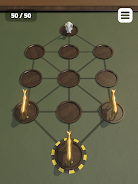
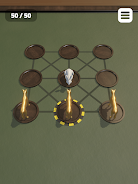
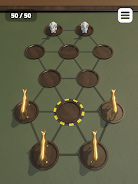
Hunter's Trap is a compact, turn-based board game that centers on positioning, planning and a single clear objective: trap the Hare or Hares so they can no longer move. In Hunter's Trap you tap a Hound piece to select it and then tap a destination to move; when a Hare is immobilized with no available moves it is treated as captured and removed from the board. This straightforward control scheme and unambiguous capture rule make Hunter's Trap easy to pick up while offering a lot of room for tactical thinking.
The game emphasizes tight, tactical encounters rather than long sessions: short matches and deliberate turns let you focus on spatial reasoning. The capture-by-trapping mechanic is simple to learn but produces deep consequences as you start to read the board several moves ahead. Visual elements are intentionally clean so piece positions and possible moves are always obvious, and the interface keeps interaction limited to a few well-defined actions to avoid accidental inputs.
Gameplay revolves around controlled movement and denying escape routes. Hounds move to block and corner, while Hares must find paths that preserve mobility. Because capture happens when a Hare cannot move in any direction, players must think about multiple axes of control and how a single placement can create chains of restraint. Matches reward foresight: a successful sequence will progressively reduce the opponent's options until a capture is forced.
Controls are intentionally minimal: select a Hound by tapping it, then tap the destination square to execute a move. The interface highlights valid destinations so you always know what moves are legal. Menus and prompts are kept concise and readable, making it easy to learn the rules from the in-game prompts without needing a long manual. Input is optimized for touch devices so actions feel immediate and responsive.
Hunter's Trap introduces mechanics gradually through a series of scenarios and puzzles that increase in complexity. Early puzzles teach basic trapping patterns and defensive responses, while later levels present multi-step problems that require planning several turns ahead. Difficulty tiers provide a clear progression for players who want to develop their skills, and challenge scenarios present fixed starting positions that test specific techniques and responses.
The visual presentation favors clarity over ornamentation: high-contrast pieces and readable board markings help you assess positions at a glance. Accessibility options let you adjust contrast and touch sensitivity so the interface adapts to different devices and player needs. Sound and simple visual feedback underline important events such as captures without getting in the way of concentration.
Replayability comes from varying starting positions, multiple difficulty levels, and a collection of puzzle scenarios that can be revisited to beat previous move counts or try alternate strategies. Because the ruleset is focused, games are quick to restart and encourage iterative improvement; trying to solve a position in fewer moves or under tighter constraints becomes its own self-imposed challenge. The compact rule set encourages experimentation with different trapping patterns and diverse tactical approaches.
Hunter's Trap runs entirely locally and requires no online connection to play, so you can practice puzzles and play matches offline. The design includes large touch targets and optional visual adjustments to support players with different abilities. Short match length and clear rules make the game suitable for brief sessions on mobile devices while still offering depth for longer study sessions.
Hunter's Trap offers focused, thoughtful matches that prioritize strategic decision-making and positional awareness. If you enjoy games that reward planning, pattern recognition and steady skill growth, Hunter's Trap provides a tidy, well-signposted environment to practice those abilities, with a measured progression, accessible controls and visual clarity that help keep attention on the board rather than on complex menus.