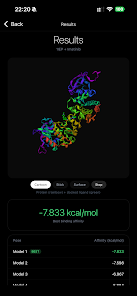
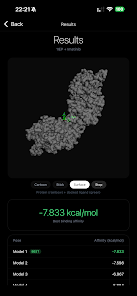
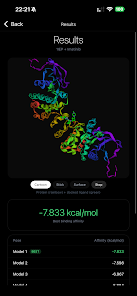
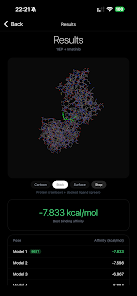
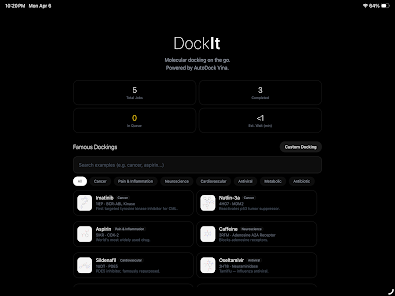
Dock It - Protein-Ligand Dock brings molecular docking onto your phone or tablet, letting researchers, students and curious users predict how small molecules bind to protein targets. The app packages the docking engine AutoDock Vina into a mobile-friendly interface so you can search large structure and compound collections, prepare proteins and ligands, set docking parameters, submit jobs to a cloud server and inspect results in an interactive 3D viewer. Dock It - Protein-Ligand Dock is ideal for quick hypothesis testing, teaching, or preliminary virtual screening when you want binding scores and visual models without a desktop workstation.
⭐ Search a library of over 200,000 protein structures from public structure repositories and load them directly into the app for analysis.
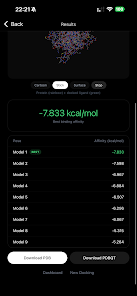
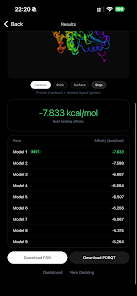
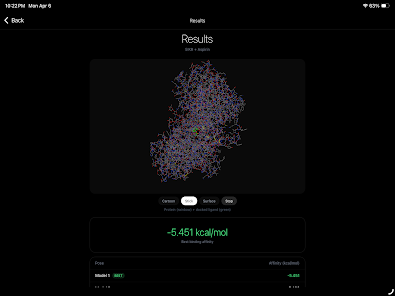
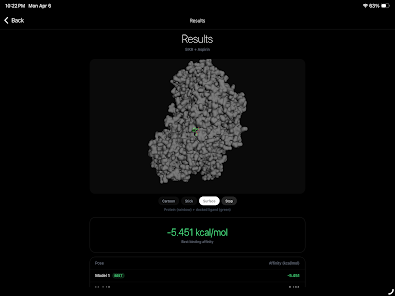
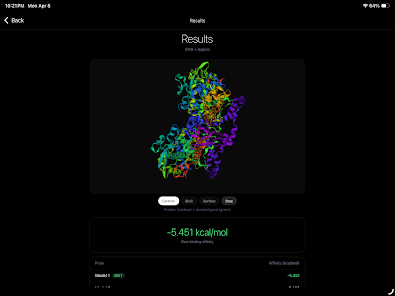
⭐ Interactive 3D viewer with cartoon, stick and surface display modes to inspect binding sites and overall folds.
⭐ Find more than 100 million compounds from major public chemical databases by name, and view formula, molecular weight, SMILES and 2D structures.
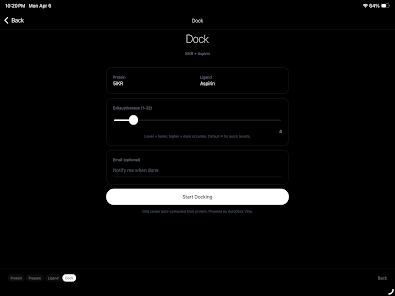
⭐ Configure AutoDock Vina parameters such as exhaustiveness, submit jobs to a cloud server, and receive computed binding affinities.
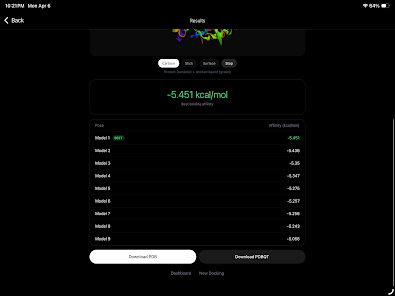
⭐ Receive up to nine docked poses per job and explore docked complexes with a rainbow-colored protein and highlighted green ligand overlay.
⭐ Instant access to 16 well-known drug–protein examples (including Imatinib, Aspirin, Caffeine and Remdesivir) grouped across multiple categories for quick demonstrations.
✅ Mobile access to a proven docking engine lets you run meaningful docking experiments away from the desktop.
✅ The 3D viewer and multiple display modes make it easy to visualize interactions and prepare figures for reports or teaching.
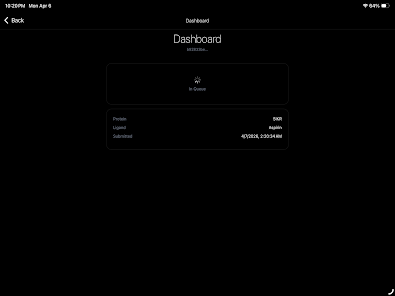
✅ Live progress updates, ETA countdown and full log history keep you informed while jobs run on the cloud.
✅ Dock It - Protein-Ligand Dock provides downloadable results in standard PDB and PDBQT formats for further analysis.
❎ Docking runs are performed on a remote server, so an internet connection is required to submit and retrieve jobs.
❎ Results are limited to up to nine poses per docking job, which may restrict exhaustive sampling for some systems.
❎ Computational docking generates predictions that help prioritize experiments but do not replace laboratory validation.
Dock It was developed by John Wonmo Seong at Seoul National University with support from Professor Juyong Lee and the Computational Drug Discovery Lab.